
By Jonathan Photius, Makrakis Research Project
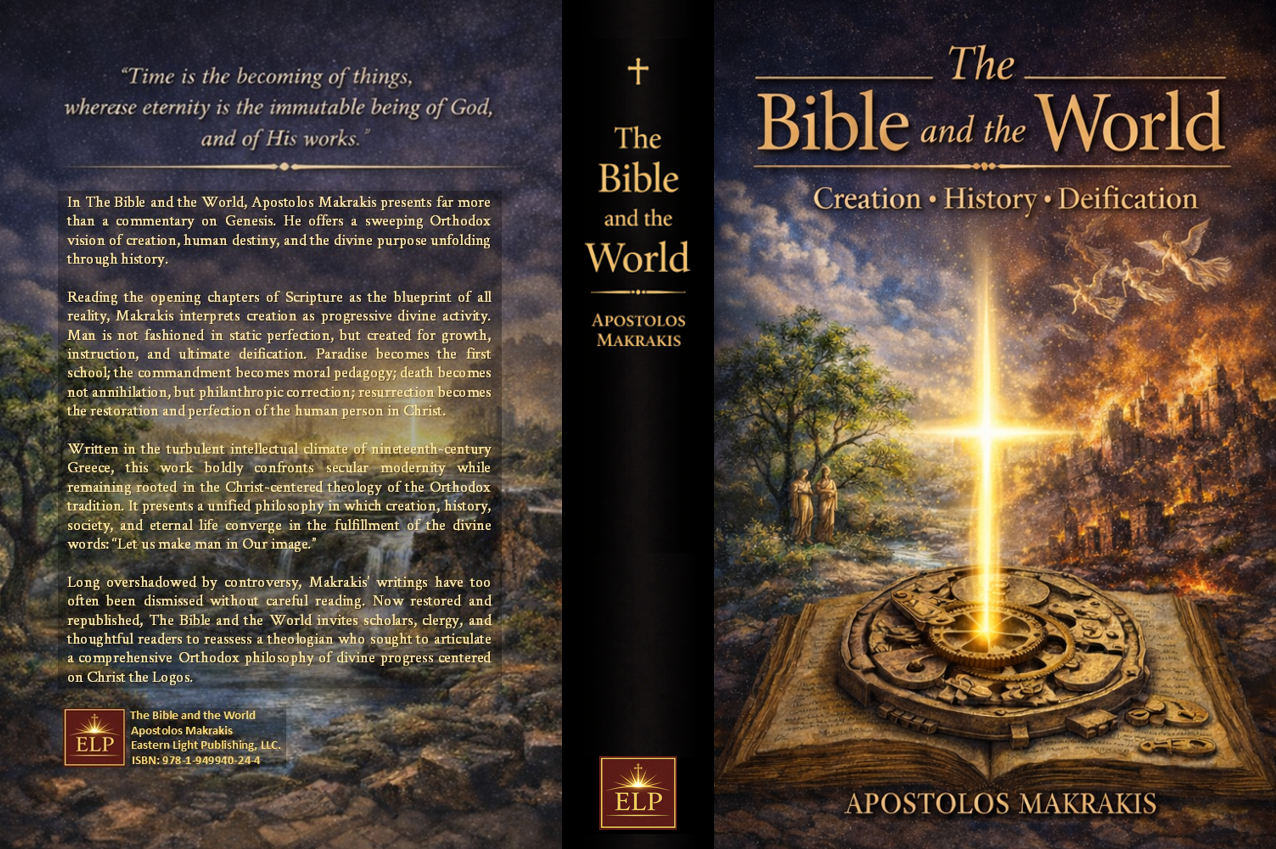
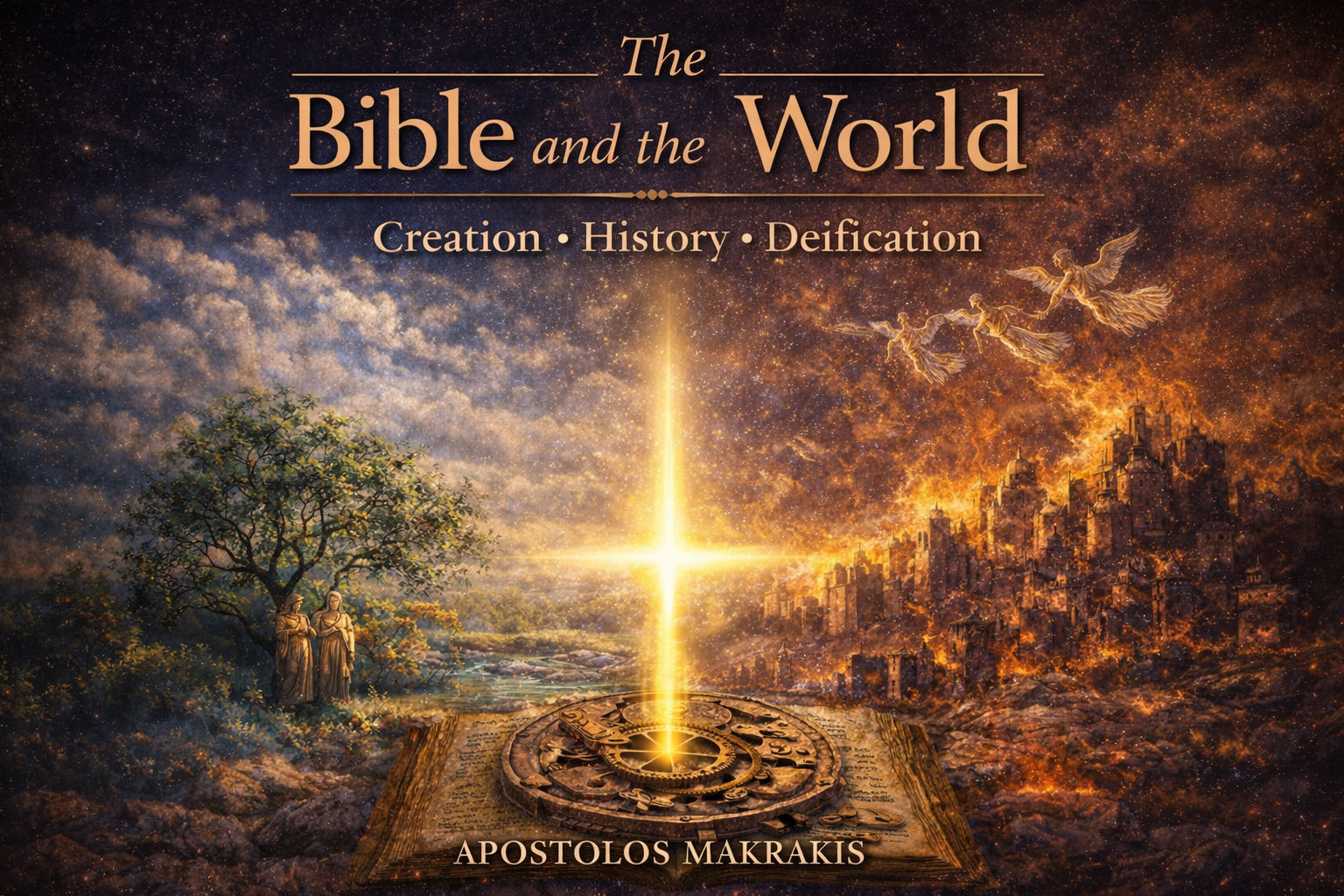
Publisher’s Note: This edition is part of an ongoing effort to digitize and republish neglected Orthodox works of the nineteenth century. Makrakis’ writings have often been treated primarily through the lens of controversy; we present The Bible and the World so it may be evaluated on its own textual and theological merits.



Introduction
In recent generations, the name of Apostolos Makrakis has too often been reduced to controversy. To some he was a polemicist; to others, a reformer; to still others, a man unfairly marginalized in the turbulence of nineteenth-century Greek ecclesiastical politics. Yet behind the accusations and caricatures stands a substantial body of theological and philosophical writing that has never been adequately evaluated on its own merits.
The Bible and the World is one of Makrakis’ most ambitious works: neither a devotional tract nor a narrow commentary, but a Logos-centered attempt to articulate an Orthodox philosophy of creation, anthropology, pedagogy, social order, and historical destiny. Written in an age when secular modernity was reshaping Greek intellectual life, it aims to recover Genesis as the seed-form of a comprehensive vision—what Makrakis calls divine “progress” toward deification.
Notably, this is not a modern rebranding. A mid-twentieth-century Orthodox summary already framed the book in precisely these terms. The Orthodox Christian Education Society (1966) described The Bible and the World as “a religio-philosophical work” in which Makrakis interprets the six days of creation “in extenso and in profundo,” treating Genesis as a key not only to origins but to human formation and the moral meaning of history. It preserved Makrakis’ own arresting thesis that the “world and the Bible are two books composed by the first and perfect Mind,” given so that humanity might receive God’s mind and become His “worthy representative in the governing of other creatures.”
This older Orthodox reception matters. It shows that Makrakis can be read—without special pleading—as a thinker attempting something recognizably Orthodox: a theological metaphysics in which creation, history, and salvation form one continuous pedagogy of the Logos. That is why the re-publication of this work is not merely archival. It is an invitation to reassess a neglected synthesis.
What kind of book is The Bible and the World? Is it doctrinally sound? And does Makrakis deserve academic rehabilitation? The best way to answer is to describe what the book actually does.
1. Genesis as the Blueprint of History
Makrakis does not read Genesis as primitive cosmology. He reads it as revelation of structure.
Creation, in his interpretation, unfolds according to a divinely ordered pattern:
- Creation (Genesis 1)
- Pedagogical formation of man (Genesis 2)
- Conflict and moral testing (Genesis 3)
- Death as corrective dissolution
- Resurrection as perfected restoration
- The Seventh Day as eternal rest
The six days signify the period of becoming; the seventh day signifies perfected being. Time belongs to process; eternity belongs to fulfillment. Thus, human history itself unfolds within the “sixth day,” while the “seventh day” prefigures the eternal communion of God and redeemed humanity.
The 1966 Orthodox summary captures this same method from another angle: Makrakis “brings to light many hidden truths” by moving from the physical to the moral—out of light and darkness, he draws moral illumination and moral obscurity; out of day and night, moral clarity and moral night. Whatever one thinks of every particular move, the underlying claim is coherent: Genesis is not merely about what the world is, but about what the human person is for—“Let us make man in Our image, after Our likeness.”
This is not allegory for its own sake. It is teleology.
2. Man Created for Growth, Not Static Perfection
One of Makrakis’ most significant theological contributions is his rejection of the idea that Adam was created intellectually and morally complete in a finished state of knowledge.
In his view, Adam was created:
- Innocent but infantile
- Pure but undeveloped
- Destined for growth through divine pedagogy
Paradise is therefore not merely a garden but the first school. The commandment introduces moral freedom; obedience becomes formative; discernment becomes the pathway from image toward likeness.
This developmental anthropology resonates more closely with the patristic vision of maturation than with later static models. Man is not created as a completed deity who collapses; he is created as a pupil destined for gradual theosis.
Here again, the 1966 summary is useful—not because it proves Makrakis right, but because it shows that Orthodox readers could recognize his intent. It notes that he interprets creation in a way that moves from “the work to the worker,” treating Genesis as a training in knowledge of God and of the human vocation.
3. Death as Philanthropic Judgment
Perhaps nowhere is Makrakis’ originality more evident than in his explanation of death.
He defines death not as annihilation but as dissolution: the separation of constituent elements returning to the ground from which they were taken. Using an analogy of a crafted object disassembled by its maker for repair, he argues that death is permitted in order to restore what was injured by sin, particularly the integrity of free will.
Death is therefore:
- Judicial, yet medicinal
- Bitter, yet temporary
- Corrective, not final
Resurrection is not mere spiritual survival but the reconstitution of the human person in incorruption. The perishable puts on imperishability. What was damaged is restored in superior condition.
Importantly, Makrakis pairs this hope with moral seriousness. He affirms eternal judgment alongside eternal life. His framework is “philanthropic” without collapsing into sentimentality.
The 1966 summary highlights one key point of controversy: Makrakis’ interpretation of the “day of death” in Genesis, which it says “all other commentators have misunderstood.” Whether or not one agrees, the claim reveals the book’s posture: Makrakis is not offering pious reflections; he is disputing interpretive traditions and proposing a systematic alternative.
4. The Two Seeds and the Drama of History
Genesis 3:15 becomes for Makrakis the seed of all history: the conflict between the seed of the woman and the seed of the serpent. This is not merely individual morality but civilizational conflict—between obedience and rebellion, Christ and anti-Christ, truth and delusion.
Here his theology intersects naturally with his broader historical vision. Even where a reader brackets his later eschatological applications, The Bible and the World clearly assumes that history is progressive divine activity moving toward final victory. The serpent’s head is not crushed in a single instant but through the unfolding of God’s redemptive plan within time.
His optimism is not political idealism. It is Logos-teleology: Christ as the end (telos) of creation.
5. Marriage, Society, and the City of God
Genesis 2 functions for Makrakis as the foundation of social order. Marriage is not a concession to sin but part of the original design. Family becomes the seed of city; city the seed of society. Pedagogy and politics must be arranged according to divine order if humanity is to approach its destiny.
Makrakis’ concern with education is especially prominent. The 1966 summary preserves his critique of modern “progress,” noting that he challenges the reduction of progress to material advancement while “contemning spiritual things and progress in respect to God.” He even turns a philological point into a cultural polemic, criticizing the “seat of plagues” (a phrase it notes is mistranslated in English versions as “seat of the scornful”) as a symbol for pseudo-intellectual production severed from moral formation.
Whether one appreciates his rhetorical severity or not, the aim is clear: knowledge without the Logos becomes deformation, not formation. Education must be ordered toward virtue and God, not technique alone.
6. Is There Heresy Here?
The charge that Makrakis was a heretic has circulated widely, often without careful textual examination. A fair reading of The Bible and the World reveals:
- Affirmation of the Trinity
- Affirmation of the Incarnation
- Affirmation of bodily resurrection
- Affirmation of eternal judgment
- Affirmation of theosis
- Strong Christocentrism
Yes, certain philosophical expressions require careful theological clarification—especially in matters touching anthropology and the soul. His style is sometimes severe; his rhetoric can be polemical; his confidence occasionally outruns his demonstration. But in the doctrinal bones of this work, one finds not a departure from Orthodoxy but an ambitious attempt to systematize an Orthodox worldview capable of confronting modern skepticism.
Academic rehabilitation does not mean uncritical admiration. It means reading him carefully, historically, and theologically.
7. A Work in Need of Academic Reassessment
Makrakis lived in a volatile period of Greek intellectual history. His criticisms of ecclesiastical and academic institutions earned him enemies; his boldness invited opposition; controversy then obscured content.
Now that his writings are being digitized, translated, and republished, a more measured assessment becomes possible. The Bible and the World is:
- Systematic
- Christocentric
- Teleological
- Historically conscious
- Philosophically structured
It deserves engagement rather than dismissal—especially for Orthodox thinkers interested in an integrated philosophy of creation and history anchored in the Logos.
Conclusion
The Bible and the World is not a relic of nineteenth-century polemics. It is a substantial theological synthesis rooted in Genesis and oriented toward theosis. It interprets creation, history, death, and resurrection within a unified divine purpose culminating in eternal communion.
The mid-century Orthodox summary called it a “hidden treasure, brought to light by the wise interpreter.” That phrase is not a final verdict, but it is a fair invitation. This work should be tested, not ignored.
As Makrakis’ writings re-emerge into public view, it may be time not merely to remember Apostolos Makrakis—but to reassess him.
 Apostolos Makrakis
This is excellent book!!! I have done it mordent Greek. I would give it to someone who wants to publish it.
LikeLike