
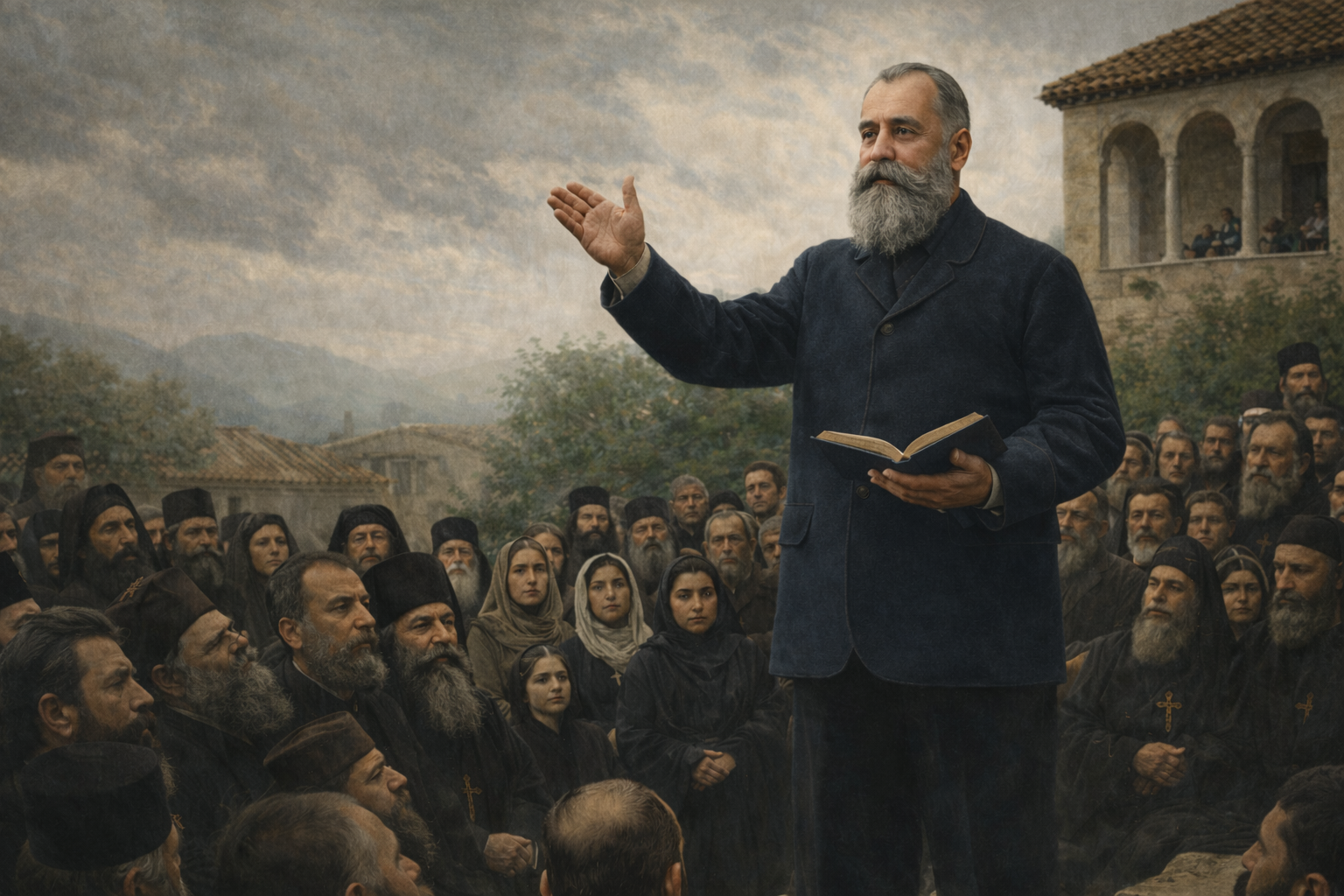
By Jonathan Photius, Makrakis Research Project
A Contested Figure in Modern Greek Orthodoxy
Apostolos Makrakis remains one of the most controversial and misunderstood figures in modern Greek Orthodoxy. Celebrated by admirers for his intellectual brilliance and fearless defense of the faith, yet criticized by opponents for his severity and polemical temperament, Makrakis occupied a public role unlike almost any other Orthodox lay theologian of the nineteenth century.
Much of what is written about him today relies on later summaries, institutional judgments, or ideological caricatures. For that reason, contemporary testimony—especially from Orthodox clerical witnesses—is of particular importance.
One such testimony is preserved in a rare 1896 work by Hieronymos Oikonomos, an Orthodox monk and cleric who personally witnessed many of the events surrounding Makrakis’ public career. Writing not as a distant historian but as a close observer embedded in ecclesiastical, academic, and journalistic circles, Oikonomos offers a uniquely balanced account—defending Makrakis where he believed the truth had been distorted, while openly acknowledging his excesses and faults.
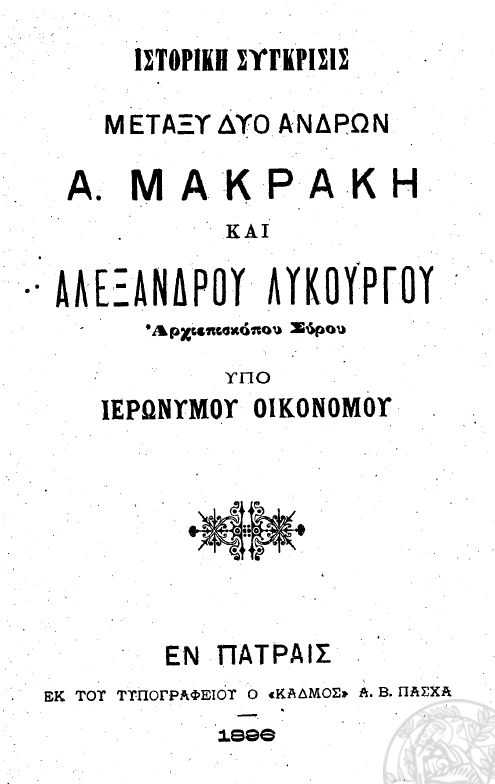
A. Makrakis and
Alexander Lykourgos (Archbishop of Syros)
By Hieronymos Oikonomos
Makrakis as a Public Intellectual and Apologist
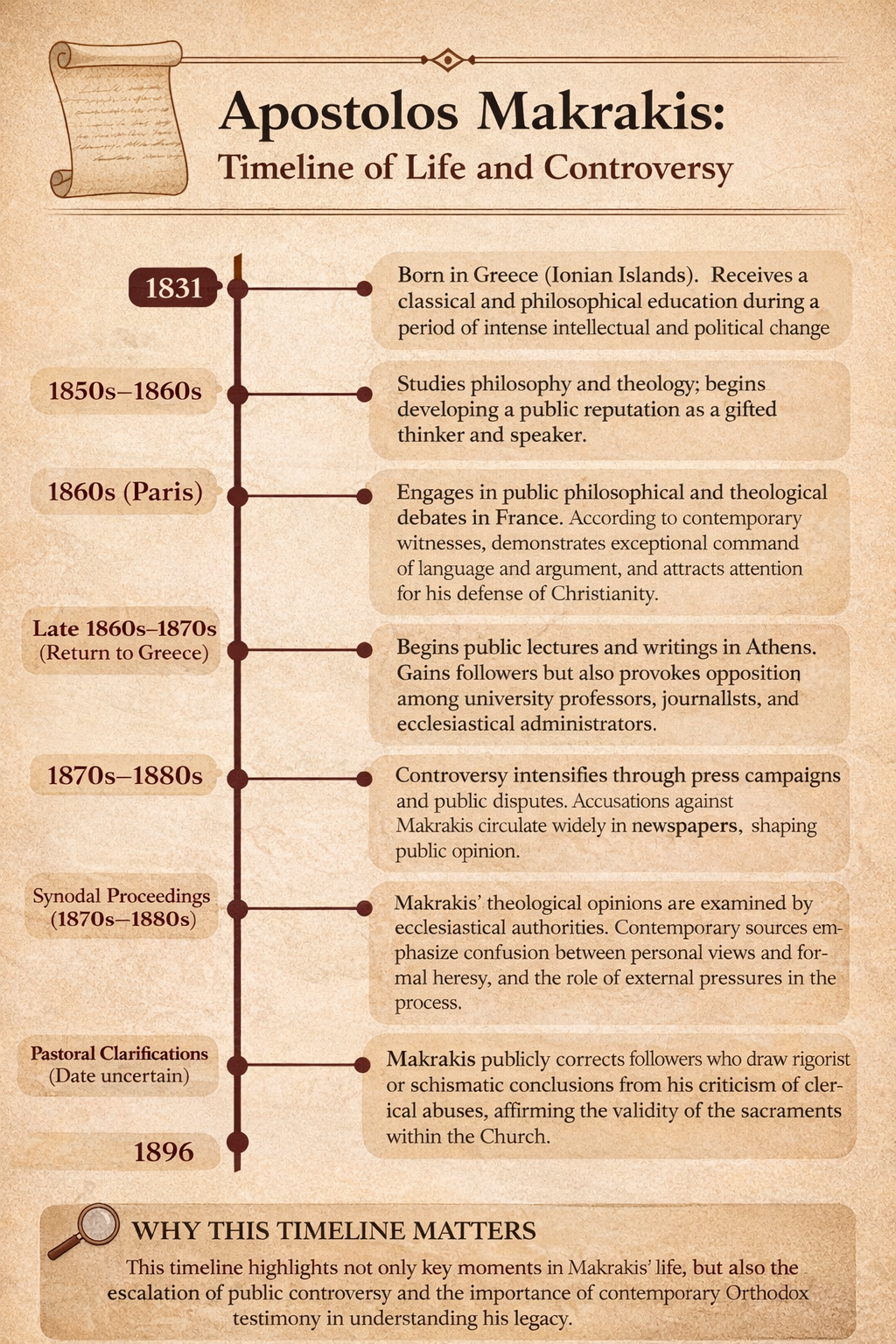
According to Oikonomos, Makrakis emerged as a formidable public intellectual through his philosophical and theological engagements both abroad and in Greece. His activity in Paris is particularly emphasized, where he debated leading intellectual figures and demonstrated exceptional mastery of language, logic, and argumentation.
These encounters were not merely academic exercises. In Oikonomos’ telling, they were apologetic confrontations aimed at defending Orthodox Christianity against prevailing rationalist and materialist currents in European thought.
Makrakis’ success was measured not simply in rhetorical victories, but in ecclesial outcomes. Oikonomos highlights instances in which Makrakis’ teaching and argumentation led others to embrace or return to Orthodox Christianity—regarding this as the proper criterion for evaluating his work.
Return to Greece and the Growth of Opposition
Upon returning to Greece, Makrakis continued his public mission through lectures, writings, and sustained engagement with contemporary philosophical and theological debates. His uncompromising style attracted devoted followers, but also provoked strong resistance.
A contemporary journalistic description from Athens further confirms Makrakis’ public stature during this period. Writing in the Athenian journal Kleio, an observer described him as a powerful and fearless speaker, publicly addressing large crowds in the city square, expounding moral and religious themes drawn from Scripture, and emphasizing the ultimate triumph of Orthodox faith and Christian morality under the judgment and providence of Christ. Significantly, this portrayal reflects a broader public perception rather than the testimony of his followers alone, indicating that Makrakis was widely regarded as a serious and influential public teacher.
Opposition arose not only from theological disagreement, but from academic rivalry, journalistic hostility, and institutional unease. University professors, influential editors, and figures within ecclesiastical administration increasingly viewed Makrakis as a disruptive force.
Oikonomos emphasizes that this opposition was often amplified and shaped by the press, which played a decisive role in forming public opinion against Makrakis.
The Role of the Press and Public Unrest
A central theme of Oikonomos’ testimony is the power of newspapers in escalating the controversy. Makrakis was frequently portrayed as an extremist or dangerous innovator, often through exaggeration or misrepresentation.
These press campaigns contributed to a charged public atmosphere. Oikonomos records that unrest surrounding Makrakis’ opponents nearly led to violence, requiring intervention by civil authorities to restore order.
This context is essential for understanding how theological disputes became public crises, and how Makrakis’ reputation was shaped as much by media narratives as by doctrinal debate.
Synodal Proceedings and Doctrinal Accusations
Oikonomos provides careful detail regarding the synodal processes directed against Makrakis. He insists that many accusations were poorly defined, conflating personal theological opinions with formal heresy.
Throughout his account, Oikonomos stresses a key Orthodox principle: doctrinal condemnation requires conciliar discernment and precision, not press agitation or administrative expediency.
While he does not deny that Makrakis held controversial views, Oikonomos repeatedly argues that the manner in which these views were handled lacked restraint and clarity.
Sacraments, Simony, and the Question of Schism
One of the most important elements of Oikonomos’ testimony concerns Makrakis’ stance on sacramental life. In denouncing abuses such as simony, Makrakis spoke with great severity, and some of his followers drew radical conclusions.
Oikonomos records, however, that Makrakis explicitly corrected such excesses. Makrakis affirmed that the validity of the sacraments does not depend on the personal holiness of the minister, provided the Church has not removed him from office.
By doing so, Makrakis rejected any rigorist or sectarian position that would fracture the Church into a self-defined “pure” body. This point is especially significant, as it contradicts later claims that Makrakis promoted schism or denied sacramental grace.
A Monk’s Judgment on Makrakis’ Character
Oikonomos’ portrait of Makrakis is neither hostile nor hagiographical. He praises Makrakis’ courage, intellectual power, and devotion to Orthodoxy, but he also criticizes his temperament.
Makrakis is described as:
- severe in polemic,
- prone to excess in rhetoric, and
- often lacking the gentleness commended by the Apostle Paul for teachers of the faith.
To frame this tension, Oikonomos invokes a patristic analogy: St Basil’s judgment of Apollinarius—“I love the man, but I do not approve of everything he teaches.” In doing so, he situates Makrakis within a familiar Orthodox category: a powerful and gifted figure whose contributions require discernment, not blind allegiance or total rejection.
Why This Contemporary Testimony Matters
The enduring value of Oikonomos’ account lies in its proximity to the events it describes. As a monk, cleric, and contemporary witness, he writes neither as a detached academic nor as a partisan follower.
His testimony preserves:
- insider knowledge of ecclesiastical and academic dynamics,
- firsthand observation of public controversy, and
- a sober attempt to judge Makrakis justly within Orthodox tradition.
For readers seeking to understand Apostolos Makrakis historically—beyond slogans, caricatures, or later polemics—this contemporary Orthodox witness remains indispensable.
II: About the Author: Hieronymos Oikonomos
Hieronymos Oikonomos was an Orthodox monk and cleric active in Greece in the late nineteenth century. He moved within ecclesiastical, academic, and journalistic circles and was personally acquainted with many of the figures involved in the controversies surrounding Apostolos Makrakis.
Writing in 1896, Oikonomos was a close contemporary witness to the events he describes. His work reflects first-hand knowledge of university disputes, press campaigns, synodal deliberations, and public reactions. Unlike later retrospective accounts, his testimony preserves the immediacy and complexity of the period.
Oikonomos’ perspective is distinctly Orthodox and ecclesial. While he defends Makrakis against what he regarded as unjust accusations and misrepresentations, he also criticizes Makrakis’ temperament and rhetorical excesses. This combination of proximity, independence, and clerical responsibility makes his account an especially valuable historical source.
III. Translator/Editor’s Introduction
The text presented here is a translation of the opening section of Historical Comparison Between Two Men: Apostolos Makrakis and Alexandros Lykourgos, published in Patras in 1896 by Hieronymos Oikonomos, an Orthodox monk and cleric.
This work was written at a time when the public reputation of Apostolos Makrakis was being actively contested in newspapers, academic circles, and ecclesiastical forums. Oikonomos composed his account not as a distant historian, but as a close witness to the events he describes. He personally knew many of the figures involved, followed the controversies as they unfolded, and participated in the intellectual and ecclesial milieu of late nineteenth-century Greece.
The purpose of the present translation is not to canonize Makrakis, nor to reopen polemical disputes, but to preserve and make accessible a primary Orthodox testimony that illuminates his life and the controversies surrounding him. Oikonomos’ account is especially valuable because it is neither uncritical nor hostile: it combines defense against misrepresentation with frank acknowledgment of Makrakis’ excesses and limitations.
Readers should approach this text as a historical document—one that reflects the concerns, language, and ecclesial sensibilities of its time. Its enduring importance lies in its attempt to judge a complex figure with both truthfulness and restraint, qualities that remain essential for any serious engagement with Orthodox history.
The author, Hieronymos Oikonomos, was almost certainly a Greek Orthodox monk–cleric active in Aigion in the late 19th century. His monastic name, clerical tone, and moral posture clearly situate him within the ecclesiastical intellectual class, though he deliberately refrains from naming a monastery—likely in order to speak as an independent historical witness rather than as an institutional representative.
IV. English Translation Of “A Historical Comparison Between Two Men A. Makrakis and Alexander Lykourgos (Archbishop of Syros) By Hieronymos Oikonomos
To the Reader
Although at the beginning of the following treatise my passion may appear inflamed and I write concerning two men, nevertheless I claim a historical and not a dialectical examination of the matter. In the pages of Peloponnesos and Neologos of Patras there has arisen (and continues to arise) a contentious discussion, on the part of both Mr. Papadimitriou and Mr. M. Sakellarios, concerning a certain political disposition. The latter—I know not how—lost his footing: he departed from the field of the established discussion and fell brutally and with extreme hostility upon Mr. A. Makrakis, who had in no way wronged him, doing so with unprecedented obscurity and malice.
In this treatise, Mr. Sakellarios, insofar as he insults and heaps abuse upon the late Alexander Lykourgos, Archbishop of Syros—his own compatriot, a great man—and accuses him of faults worthy of censure, to that same degree he despises and utterly nullifies A. Makrakis as a worthless and base man.
This excess and product of a frenzied mind on the part of that man—who nevertheless demands a historical judgment of Makrakis—moved my pen, for the sake of social justice, to place the two men in comparison, so that we may see and evaluate face-to-face which of the two truly possesses education and is worthy to receive the prize of the educated.
That is to say, Mr. M. Sakellarios, by seeking to humiliate Mr. A. Makrakis, in effect undermines his own standing, rendering himself small; and with every effort he strives within Greek society, imagining that by despising him he effortlessly secures victory over the one with whom he quarrels, without… an old one. Sophistries too—arts of an old, decayed craft—and confusions repeatedly reproduced under indifferent circumstances and dispositions, for the construction of falsehood and deceit. But such fallen bodies, when examined in light of the facts, and of certain fruits and reasonings, whenever they appear wicked and rotten, are cast away together—both what was stolen and the tools of theft alike.
Perhaps the overheated mind of Mr. M. Sakellarios stirred his own tongue and his invective, and he was led—badly for himself—like a razor-wielder slashing against me, on account of the unpleasant matters concerning Alexander Lykourgos which I recounted in my treatise. He might indeed reproach me, were I to hurl back an equal tongue. But of none of these accusations do I bear any consciousness of guilt, for I narrated concerning the two men in question only what had been learned and what truly took place. In good conscience I grant none of these charges.
Against Mr. A. Makrakis I wrote at most once; and once, twice, and thrice I restrained further treatises, judging matters concerning his exalted mindset as I understood them, and as Mr. Makrakis himself immediately responded to all accusations and judgments. For this reason, and rightly and fittingly, I leave Mr. Sakellarios elevated—without continual descent into empty phrases and wretched expulsions—but I withdraw, having renounced the tongue-pain inflamed by falsehood, and together with it depart, just as one who bears an uncritical friend departs, remaining accompanied by loss.
I return, finally, in order to add, along with the treatise, the following note for the knowledge of the brethren.
Written in Aigion on the 15th of August, 1896.
HIERONYMOS OIKONOMOS
A Historical Comparison
Between Two Men
A. Makrakis
and
Alexander Lykourgos,
Archbishop of Syros
—
In issue no. 707 of the Neologos of Patras, I read a treatise by Mr. M. Sakellarios against Mr. Papalelios. In this work, Mr. Sakellarios, insofar as he praises and glorifies the already deceased Alexander Lykourgos, Archbishop of Syros, to the same extent despises Mr. A. Makrakis. Seizing upon his subject with youthful impetuosity in this treatise, it appears to me that he speaks harshly and scourge-like, brandishing his pen vindictively against Mr. A. Makrakis, as Zeus wielded his sword against the ancestors of the Greeks and against Odysseus. Both he and the other stand outside the real issue and the intended purpose, in a state of agitated mind: the one spitting at beasts instead of men, the other beating the air with falsehoods, imagining that he is overthrowing A. Makrakis. With unprecedented lack of judgment he dares to compare Bishop Alexander Lykourgos with A. Makrakis, who stands at the very edge of true and light-bearing philosophy and of God-minded and Orthodox theology.
Mr. A. Makrakis, with complete self-sufficiency and rational power, inclines forward and struggles on behalf of the prevailing evangelical principles within human society, skillfully wielding the strong and unyielding pen against every kind of doctrinal error, superstition, Masonry, unbelief, and satanic pseudo-philosophy. His struggles, his education, and his numerous writings stand before us as most truthful witnesses and most sincere advocates, testifying to his great worth.
Apostolos Makrakis, without apologizing to those who think otherwise, enters into every age and in each one speaks openly to society, calling it to instruction and enlightenment. And those from various errors who approached him and wholly surrendered themselves to reason and conscience did not hesitate to acknowledge the exceptional worth and rare qualities of this man.
I once read a description in Athens in the journal Kleio, which conveyed the general conviction of Athenian society. The description was as follows: “Here is an audacious speaker approaching nearly old age, eloquent, powerful in speech, strong in proofs, speaking in the public square before a multitude gathered daily at the appointed hour in the afternoon, discoursing on the events of the twenty-first chapter [of the Apocalypse], demonstrating with boldness and conviction that Orthodox religion and morality will triumph in the end through the struggles of the twenty-first [chapter], removing from the world our Lord Jesus Christ, who humbles and exalts and scatters the counsels of nations, since all things are subject to His divine will and judgment.” These things were written in Athens, as a counter-testimony to Kleio, by a Byzantine by origin, a man among the recognized scholars in Athens.
But Apostolos Makrakis was already known before coming to Athens, having been known in Paris, where a wealthy man had sent him to a Constantinopolitan [gentleman] with his children engaged him as a tutor. While there, he became acquainted with a learned lady, and they instructed one another reciprocally: she teaching and training him in French, and he her in Greek. He also interpreted the Gospel to her. From this evangelical interpretation there arose in her a desire to become Orthodox, for she belonged to the Papal doctrine. When the Western priests in Paris learned this, they considered it a grave matter that such a learned woman should become Orthodox.
This lady consented that a formal dialogue be held between A. Makrakis and a distinguished Western bishop, outstanding in education and trained in dialectics, and that whoever should prevail in this dialectical contest, with him she would also unite religiously. The Westerners selected one bishop, the most capable among those in Paris. The dialectical duel began. Makrakis silenced the Western bishop, drove him into so many contradictions, constrained him and pressed him with so many dilemmas that the Westerner was completely defeated on every issue. In this contest, the lady, seeing Makrakis’ triumph, cried out full of joy in the midst of the audience: “I am Orthodox, I am Orthodox,” and immediately she was baptized Orthodox. This story was known to many Greeks then residing in Paris; I myself first heard it from Mr. Aderkios, formerly of Patras, as it was narrated to him by those who were in Paris at that time. Taking occasion from this, I questioned Mr. Makrakis, and he revealed the account to me exactly as Mr. Aderkios had related it.
While remaining in Paris, Mr. A. Makrakis, for the purpose of learning the French language together with the two children of Adaldos, also conversed with a certain philosopher who was a Mason, who in the end was compelled to confess that Freemasonry too is an error which will pass away, just as so many other anti-Christian errors have passed. I heard this from Makrakis himself in Omonia Square, as he was speaking against Freemasonry before a great crowd, when the Masons in Athens threatened him by means of an anonymous letter, saying that they would kill him if he continued to speak against Freemasonry.
In Paris, Makrakis also published philosophical works in French against the false philosophy prevailing in Europe, overthrowing it decisively together with its impieties, and boldly refuting it. These were translated into Greek by Antonios Lechatzas, and whoever wishes to know them—so as to learn of Makrakis’ power in overthrowing his opponents and refuting the sophistries of unbelief—may consult them. While exercising himself in Paris, he wrote in French rhetorical and philosophical works and refuted Renan concerning the divine person of our Lord Jesus Christ.
Returning from Europe, he spoke with boldness in Athens and began to speak publicly; but the then-dulled spirit of those in Athens, not knowing his worth, regarded him as a kind of fantasist and nearly despised him, and thus he withdrew.
Afterwards, returning again to Athens, he announced for a second time that he would speak in the square of the University and Plato. When the appointed hour came, students, professors, and the people gathered densely to hear him out of curiosity. When he began to speak, all marveled at the incomparable authority of his speech; he exercised unlimited power over their souls.
Ideas came to him like snowflakes and were expressed with philosophical clarity and with the beauty of enchanting expression; his speech flowed naturally from his mouth like water from a many-springed fountain, giving great delight to the listeners and enriching their minds with philosophical contemplations.
The blessed elder Asopios was leaning against the marble column of the University, having his cloak drawn up so as to cover his face up to the nose, listening with the greatest attention, gazing intently at the speaker. When the discourse ended and the elder departed, he would say softly: “This man knows letters; this man knows letters—and we are small before him.” The blessed Philippos Ioannou would often say to those who gathered around him and wished to confront Makrakis: “Do not engage with Makrakis, for he is a formidable dialectician.”
After these things, A. Makrakis spoke publicly in Omonia Square, developing his themes with the greatest persuasiveness, where a mixed multitude of people listened to him with no less attention and delight. He then interpreted (or even simultaneously) the Hexaemeron and published it through the newspaper Logos. And as the preacher of the capital, Agathangelos Leontopoulos of Megalopolis, assured me, the professors of the University were waiting (as the blessed Euthymios Katsogris used to say) for Logos to arrive so that they might read its contents.
All admired without exception the abundance of ideas, the logical persuasiveness, the beauty of expression, and the depth and height of the concepts. But afterwards all the professors hated him and turned away, because he expressed himself in harsh terms against the University, calling it “all-rural.” The blessed Damalas, Diomedes Kyriakos, and the newspaper Aion, wishing to oppose him in print, were carried beyond the bounds of restraint by their passions under the force of anger and uncontrolled impulse.
At first the Holy Synod ignored him, then extended its right hand and recommended his journal throughout all Greece. But afterwards even it turned away from him, because of the following incident: the Archbishop of Mantineia, Theokletos, was expelled suddenly and disgracefully in a certain monastery, The monks—I do not know how—reported to Makrakis the indecency of the expression. Moved by this, he sharply rebuked Archbishop Theokletos through his newspaper. At that time the President of the Synod, unfortunately yielding to those who approached him with simplicity but not as he ought—since he paid little attention to decorous speech, so as not himself to suffer the same things—rescinded synodically the recommendation of Logos. As a result, professors and bishops alike now hated Makrakis and spoke against him. But Makrakis remained undaunted, and by testing his pen powerfully and with great experience, he overthrew all those who attacked him in one way or another.
While interpreting the Holy Scriptures, he put forward his three well-known opinions: that concerning the “Tri-composite” (Τρισύνθετον), that concerning the origin of the soul, and that concerning the perfection of human nature in Christ at the Jordan; together with these also his views concerning chiliasm.
These opinions certainly do not constitute heresies, because none of them assail any dogma established by the Catholic [i.e., Universal] Church. They are individual and indifferent opinions, and as such unquestionably have no binding force upon Christians. There exist other individual and indifferent opinions as well, says—in a footnote of his Theology—the Russian theologian and professor of the Academy of Kiev, Antonios. Therefore only those things which bear the seal of the Catholic Church are binding upon the faithful. Even the term homoousios, although derived from Holy Scripture, was not accepted by some Orthodox shepherds, for the reason that it is not contained verbatim in the Holy Scriptures; but later the Catholic Church, after much discussion, established it through the First Ecumenical Council, and it became obligatory for all Christians who wish to believe rightly in Jesus Christ; and it established also the Church established this term because of the complete truth contained in it, and as excluding from every side the entrances of heretical corruption. And the great Athanasius resisted unto blood for it together with his fellow combatants, not so much as something derived from the divine Scriptures—which human learning can distort and falsify—but as a term of an Ecumenical Council, which from God possesses infallibility, insofar as it received the oversight of the Holy Spirit, who appointed Jesus Christ for the building up of the Church.
Therefore Mr. A. Makrakis, whatever new axiom he introduces while interpreting the divine Scriptures and philosophizing upon them, is obligatorily bound—as an opinion and humble child of the Catholic Church—to submit it for the approval of the living and unceasing Church, since she is the lawful and infallible criterion in such matters concerning salvation in Christ. The divine Scriptures and the synodical decisions are the texts of the law, according to which religious matters must be conducted. But the texts of the law also require a living tribunal, through which the texts of the law are applied. We entrust the judgment of faith to no individual authority—however wise or holy—but only to the living Catholic Church, which shall also continue living and infallibly judging every day until the consummation of the age (1). But Mr. A. Makrakis, in my judgment, did not act wisely and prudently in this regard, but wish he persisted unjustifiably in attempting to impose his own individual opinions indiscriminately upon the Orthodox Christian body, and thus spoke, as it were, in a papal manner, presenting them as derived from Holy Scripture. From this, Professors Damalas, Dominikos, and Zikos—having as an ally also Metropolitan Prokopios—submitted to the Synod of that time that he be declared a heretic, not out of conviction, as I judge, but out of hatred and envy toward him, because he dialectically exposed them as mistaken in many matters.
Fortunately, among the members of the Synod there was also that prudent and learned Bishop of Phocis, David, who said to the professors that they must first prove him a heretic, and only then could the Synod declare him such. But they were unable to do so, because Makrakis accepts the trichotomy, just as Saint Irenaeus does, who divides human beings into carnal, psychic, and spiritual—and only the spiritual man. Trichotomy is likewise accepted by Gregory, the uncle and brother of the Great Basil, who struggled against Apollinarius, with the distinction that it should not be placed among the circle of necessary dogmas, because it could give rise to misinterpretations.
He confesses the treatise on Orthodoxy written by a bishop; he confesses the Proposition of Orthodoxy with many scriptural and philosophical demonstrations. He confesses, finally, the Patriarchate of Jerusalem. Moreover, the interpretation of the Psalms published by the late Cleopas, professor of Theology in our University, most experienced in theological doctrines and questions. He is a true member of the shepherding Church, and so also is the hierarch appointed by divine providence over Patras and Elis, Mr. Hierotheos, who openly said the above on behalf of the salvation of the same person; therefore, Christian priority must be given to his affectionate and paternal exhortations. and ecclesiastical philology, as is shown by his own prolegomena to the edition of the interpretation of the Psalms by Patriarch Anthimos (see also page 2).
Now the view of Mr. Makrakis concerning the soul does not assail the dogma of the soul’s immortality, but appears rather to explain more successfully the question of the transmission of original sin—concerning which the Fathers think differently and none has pronounced definitively. Indeed, with irrefutable proof, the holy Augustine hesitates to decide conclusively which of the opinions is more correct concerning the origin of the soul.
As for the perfection of the human nature of Jesus Christ at the Jordan, this does not assail the dogma of the God-Man, for he confesses Him as perfect God and perfect man. The divine nature, having ineffably assumed the human nature, both assumed it and led it to the fullness of its progress and growth in age. Perhaps one may say that Mr. Makrakis erred conceptually in defining the time of this fullness exclusively at the Jordan—where at that time, by every indication, He was shown through the descent of the Holy Spirit in the form of a dove to be the Son—but in any case the dogma is not assailed in its essence.
Makrakis accepts chiliasm, as Saint Irenaeus and many others do—not as the abhorrent Jewish chiliasts who imagined the resurrection and restoration of the Jewish synagogue with carnal and shameful pleasures, but as a vision of Christianity with spiritual and divine delights. (On this subject I explain more clearly and at greater length in my work entitled “The Struggle between Religious Newspapers”.) But the Church did not declare Saint Irenaeus a heretic on account of the above views; only Saint Dionysius of Alexandria criticized them toward chiliasm, the unskillfulness of Saint Irenaeus. For these reasons the Synod refused to declare Makrakis a heretic, as the professors Damalas, Diomedes, and Zikos desired; but the professors departed, brooding revenge against Makrakis and seeking an opportune time.
That Synod was dissolved, and in the next formation of the Synod the Archbishop of Mantineia, Theokletos, came as a synodal member—he with whom the others had previously clashed over Makrakis because of certain novel expressions of his, the two sides insulting one another most disgracefully. The Bishop of Kalavryta also remained for a second year as a synodal member, and he himself narrated to me the following events.
“In the new Synod, through the persistent activity of the aforementioned professors, and the servile cooperation of the previous secretary Damaskinos, Makrakis was again discussed on account of his opinions. Knowing that the trichotomy would have to be declared heretical synodically, Metropolitan Prokopios and Theokletos of Mantineia wanted and desired this; but I resisted and insisted upon the decisions of the former Synod, and the matter remained undecided. Suddenly, one evening a person visited me from the king’s most trusted circle and told me that the king wondered how you could defend Makrakis, who was allegedly working to depose him from the throne and ascend himself. I was shaken at hearing this, knowing what was happening. But not wishing to displease the king, I yielded to the repudiation of Makrakis as a heretic, and at the next session he was unanimously repudiated synodically by encyclical. As the blessed Damaskinos told me, in the drafting of the synodal encyclical the secretary and the three professors—Damalas, Diomedes, and Zikos—and Theokletos of Mantineia took part. In the draft the opinions of that time were substituted, and the ideas and phrases were repeatedly altered.”
Each strove zealously to burden Makrakis more than the other. At last, when the document was compiled, it was sent to the press. Damalas hastened to read the first sheet together with the secretary Damaskinos; and after reading it, upon returning he said that the encyclical was such that Makrakis would lose it like a star casually extinguished.
Nevertheless, it was sent everywhere to be read in the churches. Certainly the more prudent scholars valued it little, but the simple and devout people listened—as was natural—with reverence, and thus came to hate Makrakis thoughtlessly. But whether the Synod declared him a heretic out of conviction or out of passion, the simple Christians were not capable of discovering and discerning this; consequently the current of public opinion rushed against Makrakis, prevailed, and thus was preserved. Yet when the appendix was published in Patras, the onslaught was moderated. A certain cleric accused me before the Synod as the author of the appendix, and an official apology was demanded of me by the Holy Synod. I gave the appropriate response, and the Synod was satisfied with my apology.
After this began the matters of simony, which we omit here for the sake of brevity, since they are widely known as they circulated, and concerning which Makrakis’ righteous and holy zeal against simony was evident. At that time I myself was not a little opposed to Makrakis, not accepting the excesses produced by his zeal. His followers proclaimed that the sacraments performed by simoniacs were invalid and false. Makrakis himself never explicitly expressed this—as far as I know—but nevertheless he tolerated it and silently approved those followers who preached in this manner. I opposed such a pernicious idea. The Fathers who wrote against simony never, as far as I know, expressed themselves against the sacraments performed by simoniacs. “He does not ordain all, but works through all,” says somewhere Saint John Chrysostom. This was proclaimed many times I explained verbally to the exceedingly imprudent followers of Mr. Makrakis, first, that present-day simoniacs are not heretics in theory but in practice. Certainly and incontrovertibly, ordinations of bishops or priests carried out through money or through the intervention of secular persons constitute in truth the greatest and most grievous crime in the Church, and for this reason must be condemned with all force and energy, both practically and verbally.
But this practical form of simony was operative even before Christ among the Jews who returned from captivity, as the Maccabean history relates, and it was customary even in the time of Jesus Christ; for this reason, almost yearly the high priests were very frequently changed. Saint John Chrysostom explicitly confesses that among the Jewish clergy this unholy commerce in the high priesthood prevailed openly and without concealment. The governor kept the priestly vestment in his own possession and gave it to the highest bidder; yet even so, says Saint John Chrysostom, divine grace was at work, and the virtuous and devout Jews came to the temple, offered their sacrifices, and worshiped God while living under such worthless and impious high priests.
Unfortunately, this evil advanced—where it ought not to have done so—even into the Church of Christ, especially in the fourth century A.D., not so much in the East as in the West. Saint Jerome, on this issue as well as against the prevailing corruption among the clergy and the Roman populace, wielded his fiery pen, writing and speaking relentlessly and fearlessly, and shook Roman society. For this reason he was hated, persecuted, and slandered as a heretic in Rome, and was finally forced to withdraw to Jerusalem, where the most learned man lived out his life in holiness. And Saint John Chrysostom, because of how greatly he was hated and passionately accused by a large part of the clergy; for, going out on visitation, he deposed many unworthy bishops, and repeatedly proclaimed publicly in church that any ordained man who knows himself to be unworthy—either before ordination or after ordination—is in every way obliged to resign from the priesthood; otherwise he is unforgivable and has no hope of salvation. Yet for this very reason our Lord also received the traitor Judas as one of the Twelve disciples, in order to prefigure that within His holy Church many traitors, like Judas, would enter unworthily. And while elaborating their sins with deliberate mastery, advancing in manifold and diverse ways toward the utmost lack of conscience, the condemnation of Judas awaits them unspeakably, if they remain unrepentant. And if in this life God does not pour out His divine wrath upon them while they remain unpurified, then in the age to come—bearing a soul heavily burdened with many sins—the wretched ones will encounter the traitor Judas in eternal condemnation.
In the end, Mr. Makrakis perceived the impropriety and excess of his own followers, and demonstrated to them in council that the sacraments are indeed performed even by simoniacs, insofar as they bear and possess the seal of the priesthood, unless it is officially removed by the Church.
From this point, the zeal of certain clerics—those of more sound mind—began to relax toward Makrakis, especially as they disapproved of the schism he had stirred up as something unwarranted. And for these reasons, a little later they subjected him to irrational reproach, and were reunited with the Church, officially and entirely rejecting all his individual opinions.
As for Mr. Makrakis, whether before or after the later generation, and examining dispassionately the matters concerning him—his theology and his other merits, his excesses and his shortcomings, and indeed even certain egoistic and unacceptable arrogances—one is no less compelled by the facts one might cry out the words of the great Basil, who once, upon reading a book of Apollinarius, said: “I love the man and admire him, but I do not praise him in all things.”
Mr. A. Makrakis is a man easily provoked and passionate, yet magnanimous and of strong nature; but the abundance of his sense of justice, and his forgiving attitude toward his enemies, drives him even into what is not fitting. He does not overcome evil by good, but rises up relentlessly against his opponent. Christian meekness does not restrain the fire of his anger, nor the vehemence of his hatred, nor the intensity of the bitterness of his soul—manifested in practical combativeness and in the proofs he brings against his adversary. In every undertaking he seizes, a sharp spirit appears in its full force; he cannot live quietly, and for this reason, both in love and in enmity, he is decisive and a follower of extremes.
Makrakis was placed by divine providence for the crushing of all dark errors, opposing delusions and heresies—but not for the peaceful building up of truth through a conciliatory approach toward those who err. In the full impulse of his zeal, he forgets the saying of the Apostle Paul: “A servant of Christ must not fight, but be gentle toward all, apt to teach, patient, in meekness instructing those who oppose themselves, if perhaps God may grant them repentance unto the knowledge of the truth, and they may recover themselves out of the snare of the devil, having been taken captive by him unto his will” (2 Timothy 2). He bears much of the polemical character of the divine Jerome, being deeply nourished, like him, in the divine Scriptures—and even beyond Jerome in the depth of interpretation of the divine Scriptures—in which he shows zeal joined with the most exact piety in all other respects, except for his personal opinions, which are not unanimously confessed by the Fathers nor synodically and definitively discussed by the Catholic Church. And once confirmed, he even surpasses the divine Jerome in the philosophical investigation of the divine Scriptures. By strong and unassailable arguments he demonstrates that right reason and divine Revelation are not opposed to one another, but are most harmoniously related, since both reason and divine Revelation are gifts given by God.
Yet human reason is weakened by the passions on account of the transgression of the divine commandment, and having been dragged through the course of the ages into the depths of corruption, it has lost its strength, becoming small and powerless, subject to folly—yet it can be restored. For this reason, at the fitting and appropriate time, divine Revelation was given to humanity by divine providence and philanthropy, gradually and in due season, until it was completed and formally established in the tradition of the perfect Revelation in Christ. Therefore, from now on human reason must be subordinated to perfect divine Revelation, and must serve it freely and conscientiously, being placed under it. The God-man Jesus Christ, the God-like and pure stream of His divine teaching, has been treasured up in the divine Scriptures and is transmitted without distortion, as through a conduit, to those who believe in Him through the Catholic Church, which is, according to the Apostle, the pillar and ground of the truth. If anyone does not belong to her in obedience through all ages, he is not a member of Christ and has no hope of salvation. “And if he refuses even to hear the Church, let him be to you as a Gentile and a tax collector.” These things and such like Mr. Makrakis teaches, and as such he is esteemed by those who are prudent and judge without passion.
While in Patras, there passed through a Protestant theologian traveling to England; among many things he expressed also this—that he had gone through almost all the universities of Europe, yet I did not find a man as learned as Mr. Makrakis. A certain cleric who came some time ago from Germany told me that, while frequently visiting the home of the renowned scholar among the Old Catholics, Döllinger—a man of learning throughout all Europe—he heard from him that in free Greece Makrakis is a philosopher and theologian, and an interpreter of the divine Scriptures among the best and rarest of men. He also expressed astonishment as to why the Greek Government does not give him a position at the University. No one can conscientiously deny that the religious movement now observed among scholars and others in Greece within Orthodoxy is owed to Makrakis.
I do not enter into melodrama; and even if, in part, recounting matters concerning Makrakis, I should err in word, I shall gladly accept correction, provided it be rational and factual, and examined from a pure and non-vindictive heart.
It would have been fitting, together with Makrakis, to follow also a strong and concise historical account of the late Alexander Lykourgos, so that we might immediately have a parallel image of the two men and compare the results of the education of Makrakis as narrated by Mr. M. Sakellarios, and of the great intellect of A. Lykourgos according to the Neologos.
But the idea occurred to me, for the knowledge and understanding of public opinion, first to investigate Mr. M. Sakellarios—what kind of religious convictions he holds, and of what system he is a follower. For from what he writes confusedly in the Neologos, one could conclude that he is a Neo-Platonic pseudo-philosopher, a follower of Plotinus, a follower of anti-Christian rationalism, and a follower of the monstrous Gnostic doctrines of Valentinus and Marcion—in short, anything other than an Orthodox Christian. For, by despising and by insulting Theodore the Studite—who in his own time struggled even unto blood for piety—he shows contempt for Orthodoxy as a whole. He despises all those shepherds and teachers of piety who in their generations contended both in deed and in word; he despises the Basils and Gregories, the Chrysostoms, treating as delusions the dogmatic achievements of the Orthodox Church and faith. He despises, in general, the theologian, philosopher, and ecumenical teacher of Orthodoxy, John of Damascus, from whom—more than from anyone else—Saint Theodore the Studite drew his irresistible arguments against the unspeakable iconoclasts. He despises those who fought at the same time as Saint Theodore for the holy icons: the many, and in learning and virtue incomparable and blessed Patriarchs Germanos, Nikephoros, and Methodios. He despises the mighty worker and teacher, the most learned Photius, who once and for all, with powerful arguments, rejected papal arbitrariness and philosophy, and secured the freedom in Christ of the Eastern Orthodox Church. He despises the great guardian of Orthodoxy, that most eminent Mark of Ephesus, who shattered the bonds of papal arbitrariness and philosophy, and trampled its pretensions insofar as they were established for the humiliation and enslavement of the Eastern Church. He despises the patriarchs who came after him and defended correct teaching—Jeremiah II—who once and for all, with strong arguments, rejected the professors and theologians of the University of Tübingen, who attempted in every way to alter the union of the Churches into a form more Protestant than Orthodox. He despises our later teachers Eugenios, Theoklēs, and our contemporary Konstantinos Oikonomos—men of strong, external, and courageous learning.
All these Mr. M. Sakellarios despises in the person of Theodore the Studite, because all these together constitute in Christ as a harmonious member of the Orthodox Church. Mr. M. Sakellarios, therefore, is not an Orthodox Christian; rather, judging from what he writes, he appears to me more as a rationalist. And what else is this if not irrationality and satanism?

