
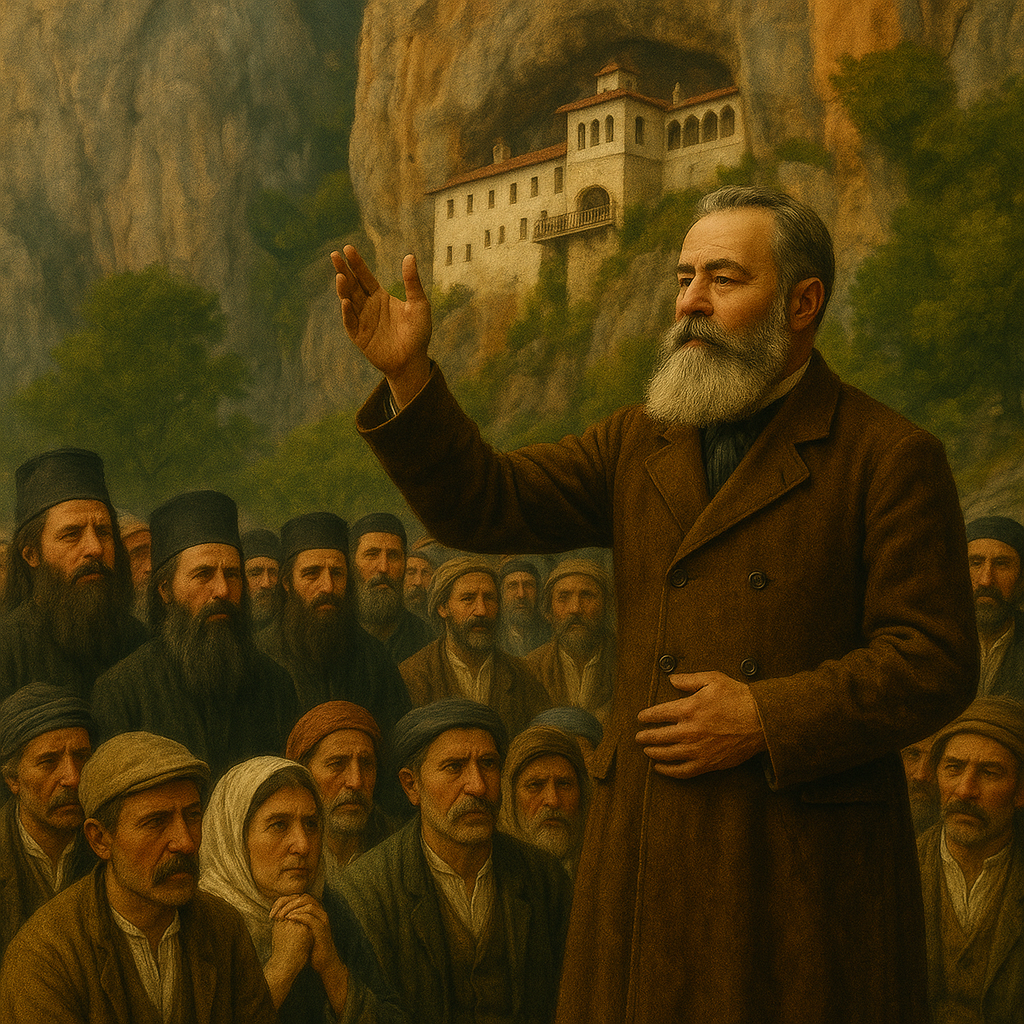
By Jonathan Photius – Makrakis Research Project
Abstract
This article examines the principal theological accusations leveled by the Athonite monk Theokletos Dionysiates against the nineteenth-century Greek lay theologian and reformer Apostolos Makrakis (1831–1905). Dionysiates’ criticisms—rooted largely in misinterpretation, selective quotation, and unfamiliarity with philosophical theological language—have shaped modern perceptions of Makrakis. Drawing on the systematic rebuttal of Greek Orthodox theologian and professor Christos I. Adamopoulos of Athens, this study evaluates each charge in light of Scripture, patristic anthropology, and Orthodox doctrinal history. The findings demonstrate that Makrakis’ teaching is deeply rooted in the patristic tradition and that the accusations against him arise from methodological inconsistencies and theological misunderstandings rather than genuine doctrinal deviation.
I. Introduction
Few modern Greek Orthodox thinkers have generated as much controversy as Apostolos Makrakis. Though widely admired for his moral clarity and intellectual vigor, he has also been treated with suspicion—particularly by monastic critics who were uncomfortable with his analytic style and vigorous public preaching. Among these critics, the Athonite monk Theokletos Dionysiates stands out for the severity and longevity of his attacks.
Dionysiates accused Makrakis of doctrinal innovation, false anthropology, rationalism, spiritual danger, and even proximity to Theosophy. His work was framed as a warning to the faithful, but as Adamopoulos demonstrates, it was based on a profound misunderstanding of Makrakis’ terminology and theological method.
This article analyzes Dionysiates’ principal accusations and contrasts them with the careful refutation offered by Adamopoulos, situating the debate within the broader history of Orthodox anthropology, ascetic theology, and lay theological teaching.
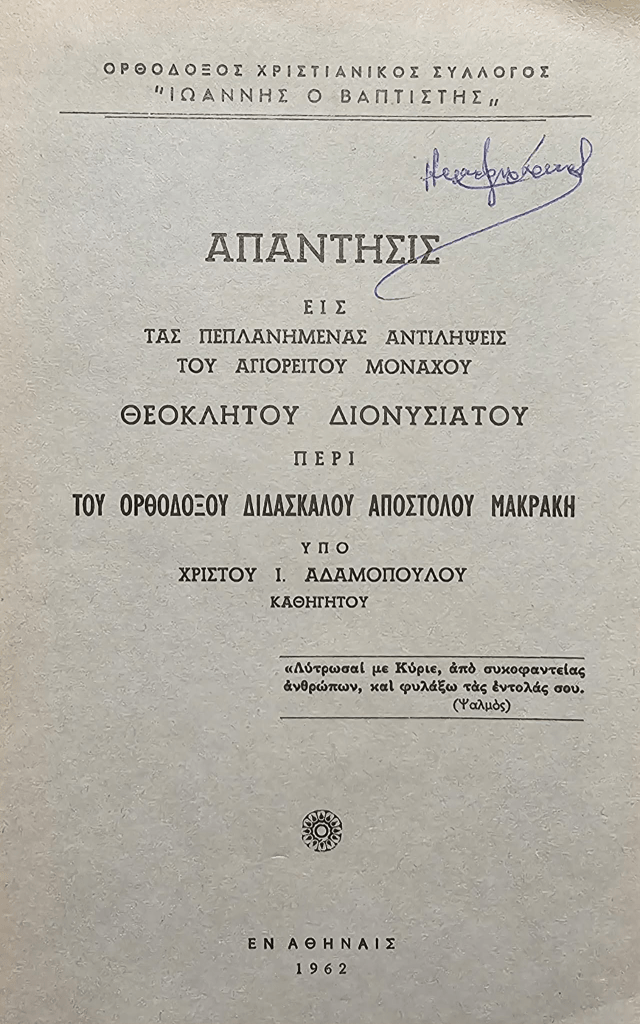
The 24-page Greek pamphlet (shown below) was published in 1962 by Adamopoulos, a Greek priest in Chicago. I have translated the contents and summarized the main points below.
II. Historical and Ecclesiastical Context
Makrakis lived and worked in a turbulent period of Greek history marked by:
- the rise of Western rationalism,
- declining sacramental practice,
- moral laxity among clergy and laity,
- intense cultural nationalism,
- competing models of education and spiritual formation.
The Church was struggling to regain its footing after centuries of Ottoman rule. Many clergy were poorly educated; catechesis was weak; and the influence of secularist and Masonic ideologies was growing.
Makrakis responded with a renewed call to:
- repentance,
- moral purification,
- frequent Communion,
- Scriptural literacy,
- public witness.
His lay preaching, rooted in Scripture and the Fathers, drew thousands. But it also provoked discomfort within ecclesiastical hierarchies and certain monastic circles, especially among those wary of philosophical analysis in theology.
Dionysiates’ critique reflects this tension between monastic apophatic intuition and systematic lay theological expression.
III. The Methodological Problem in Dionysiates’ Critique
A consistent issue emerges in every accusation: Dionysiates reads Makrakis’ technical vocabulary through the lens of monastic ascetic discourse rather than the philosophical-theological idiom Makrakis employs.
This leads to three recurrent distortions:
- Mistaking terminology for doctrine
Dionysiates assumes Makrakis’ use of the word “spirit” (pneuma) refers to the Holy Spirit, when Makrakis clearly means the created spiritual faculty of the human person. - Ignoring textual context
Accusations rely heavily on isolated phrases divorced from Makrakis’ repeated clarifications. - Projecting modern anxieties onto 19th-century texts
Dionysiates interprets Makrakis through the lens of 20th-century monastic concerns rather than in the context of 19th-century moral and educational reform.
Adamopoulos’ study demonstrates that these misunderstandings—not doctrinal deviations—form the foundation of the critique.
IV. Anthropology: Body, Soul, and Spirit
The most serious charge is that Makrakis teaches a “false anthropology,” confusing the created human spirit with the uncreated Holy Spirit. This stems from his use of the Pauline triad:
“May your spirit, soul, and body be preserved blameless.” (1 Thess 5:23)
The Fathers, including St. Maximus the Confessor, St. Basil the Great, and St. Gregory of Nyssa, frequently employ similar distinctions. Some Fathers speak of:
- nous,
- psyche,
- hegemonikon,
- pneuma,
- multiple faculties within the soul.
Makrakis stands firmly within this tradition.
Adamopoulos’ core rebuttal:
- The human spirit is created; it is the apex of the rational faculties, not the Holy Spirit.
- The Holy Spirit is uncreated and grants grace to the human faculties.
- Illumination ≠ identification.
- The distinction is wholly patristic and Palamite.
Dionysiates’ accusation thus collapses, since Makrakis’ anthropology matches the Fathers far more than the simplistic dualism Dionysiates prefers.
V. Rational Soul and Human Faculties
Dionysiates claims Makrakis “denies the rational soul.” In fact:
- Makrakis affirms the traditional “rational and intelligent soul” of man.
- He analyzes its powers in a more detailed, philosophical way.
- His distinctions align with Maximus’ differentiation of nous, logos, and dianoia.
Adamopoulos notes that Dionysiates mistakes description for negation. Simply because Makrakis parses the rational soul into its operative functions does not mean he denies its essence.
This accusation fails on semantic grounds before it even reaches doctrinal evaluation.
VI. Zeal, Moral Reform, and the Charge of Excess
Dionysiates criticizes Makrakis’ preaching style as overly passionate and “dangerous.” Yet the Fathers praise zeal when directed toward truth:
- St. Elijah,
- St. John the Baptist,
- Christ cleansing the Temple,
- St. Paul’s rebukes,
- St. John Chrysostom’s denunciations of corruption.
Adamopoulos argues that Makrakis’ zeal was not a psychological imbalance but a prophetic moral response to widespread spiritual decay. The fruits of his ministry—repentance, confession, renewed piety—demonstrate divine blessing, not excess.
VII. Lay Teaching and Ecclesiastical Order
Another major accusation is that Makrakis, as a layman, had no right to teach theology publicly.
Adamopoulos counters with historical and canonical evidence:
- Many Church Fathers, including several early catechists, taught before ordination.
- Lay theologians and apologists played a decisive role in the early Church.
- Makrakis did not assume priestly functions; he taught Scripture, morality, and doctrine.
- Moral exhortation is not restricted to clergy.
Makrakis defended the hierarchy while calling for repentance among clergy and laity alike.
VIII. Frequent Communion: Innovation or Restoration?
Dionysiates accuses Makrakis of dangerous innovation for urging frequent Communion.
Adamopoulos notes:
- The ancient Church practiced weekly Communion.
- Apostolic Canon 9 presupposes it.
- The Fathers frequently admonish the lax to approach more often.
- The later reduction to three times per year was a pastoral measure for penitents, not the faithful.
Thus, Makrakis restored patristic practice rather than innovating.
IX. Scriptural Interpretation and Patristic Exegesis
Dionysiates faults Makrakis’ interpretation of passages such as “Dust you are” and “Dust you shall eat.”
Adamopoulos shows that:
- “Dust you are” refers to the body, per all patristic authorities.
- “Dust you shall eat” is interpreted spiritually by Cyril of Alexandria and others.
- Makrakis reads Scripture through the patristic lens; Dionysiates reads it literalistically.
The accusation reflects hermeneutical inconsistency, not Makrakis’ error.
X. The 1879 Synod and Its Misuse
Dionysiates treats the Local Synod of Athens (1879) as evidence of formal condemnation. Adamopoulos emphasizes:
- Makrakis himself was never summoned.
- The propositions condemned were ambiguously worded.
- The Synod had no ecumenical or dogmatic authority.
- Several bishops later questioned its findings.
Using the Synod to declare Makrakis heretical is historically and canonically invalid.
XI. The Fruits of Makrakis’ Ministry
Every accusation must ultimately be judged by fruit, as Christ commands. Makrakis’ ministry produced:
- repentance and confession,
- renewed piety,
- Scripture study,
- frequent Communion,
- moral courage,
- lay theological education,
- missionary enthusiasm.
These fruits contradict the narrative of spiritual danger presented by Dionysiates.
Adamopoulos concludes: Makrakis’ spiritual legacy is evidence of grace, not error.
XII. Conclusion
A systematic examination of Dionysiates’ accusations reveals a consistent pattern: misreading terminology, ignoring context, rejecting philosophical clarity, and minimizing patristic diversity. None of the charges withstand theological or historical scrutiny.
Adamopoulos’ defense demonstrates that:
- Makrakis’ anthropology is patristic,
- his zeal is prophetic,
- his moral preaching is traditional,
- his doctrine is Orthodox,
- and his legacy is spiritually fruitful.
Far from being a heretic or innovator, Makrakis stands as a bold lay theologian who sought to awaken the conscience of a nation drifting into spiritual lethargy. His work deserves renewed scholarly attention and a fair reassessment in light of Orthodox tradition.

