
By Jonathan Photius, Makrakis Research Project
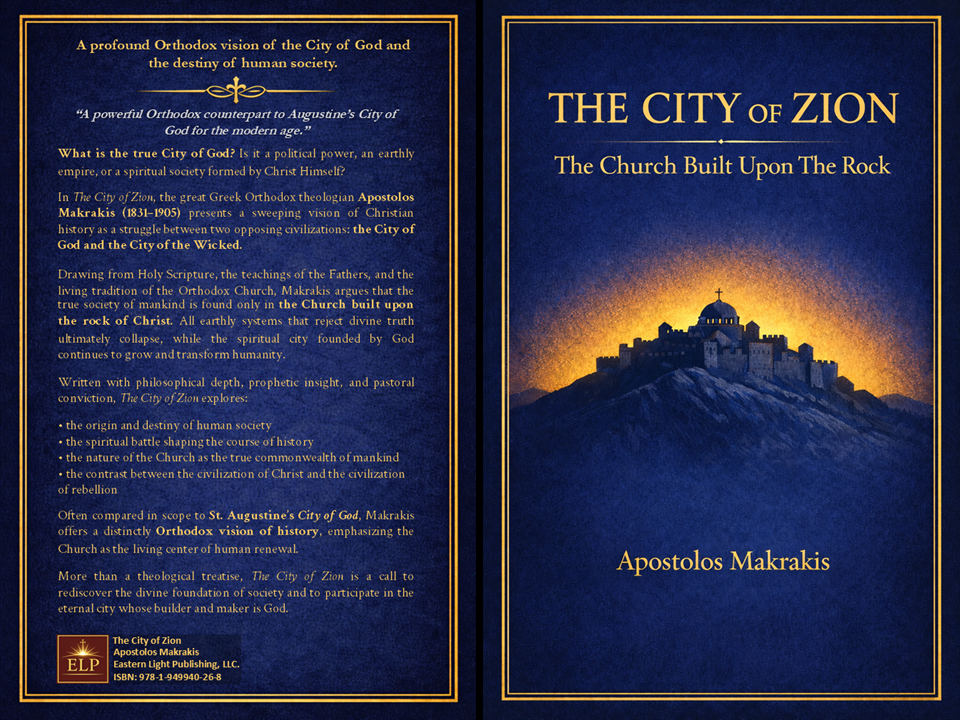
Publisher’s Note: This edition is part of an ongoing effort to digitize and republish neglected Orthodox works of the nineteenth century. Makrakis’ writings have often been treated primarily through the lens of controversy; we present The City of Zion so it may be evaluated on its own textual and theological merits.
“The Church is the divine society established by Christ.” -A. Makrakis, The City of Zion
Introduction
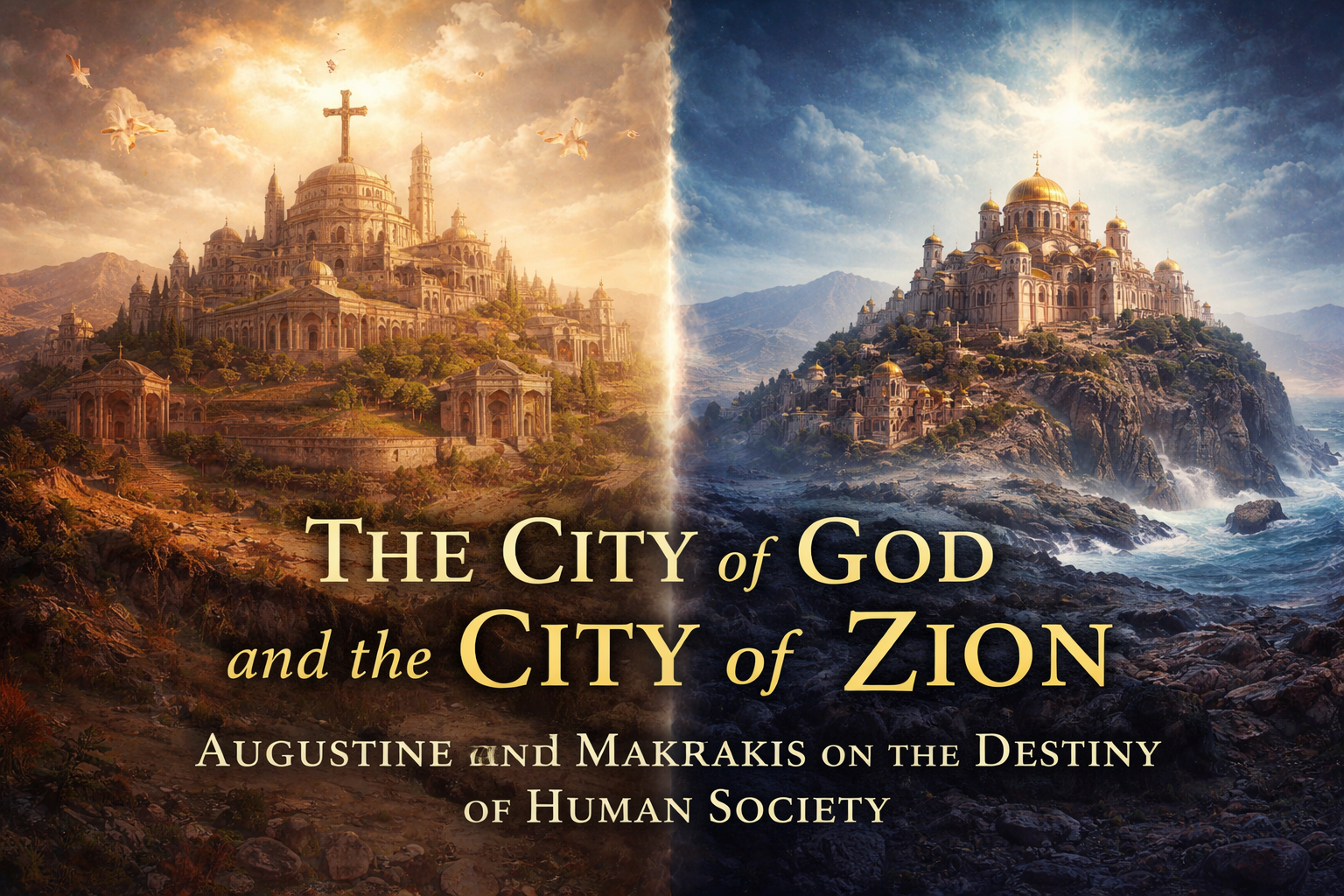
Few works in Christian history have shaped the understanding of society and history as profoundly as the monumental City of God written by Augustine of Hippo in the early fifth century. Composed in the aftermath of the sack of Rome in A.D. 410, Augustine’s work responded to the accusation that Christianity had caused the collapse of Roman civilization. His answer was to frame the entire drama of history as a conflict between two societies: the City of God and the earthly city.
More than fourteen centuries later, the Greek Orthodox theologian Apostolos Makrakis revisited this same theme in his remarkable work The City of Zion. Writing in the turbulent intellectual and spiritual climate of the nineteenth-century Orthodox world, Makrakis developed a distinctly Orthodox vision of the struggle between the divine society founded by Christ and the opposing city of rebellion.
Although separated by centuries, the two thinkers share striking structural similarities in how they interpret history and society.
Historical Setting
Augustine wrote during a moment of profound civilizational crisis. The sack of Rome in 410 shook the Roman world, and many pagans blamed Christianity for weakening the empire. Augustine responded by arguing that Rome itself belonged not to the eternal City of God but to the earthly city shaped by human pride and ambition.
Makrakis wrote under very different circumstances but faced a crisis of his own. The Orthodox world had emerged from centuries of Ottoman domination and was confronting powerful new forces: secularism, Western ideological influence, internal ecclesiastical compromise, and moral decline. Like Augustine, Makrakis interpreted these tensions not merely as political events but as manifestations of a deeper spiritual conflict.
Both authors therefore write during periods of civilizational uncertainty and attempt to interpret that crisis through the lens of Christian theology.
The Framework of the Two Cities
At the heart of Augustine’s work lies the famous distinction between two cities defined by two loves. The City of God is formed by the love of God even to the contempt of self, while the earthly city is formed by the love of self even to the contempt of God.
These cities are not merely political entities. Rather, they represent two spiritual orientations that exist throughout history, often intermingled and only fully separated at the final judgment.
Makrakis presents a similar but more explicitly structured framework. In The City of Zion he describes two opposing societies governed by two principles: the City of the Good One, which he identifies with Zion, and the City of the Wicked One, symbolized by Babylon.
These cities are defined not simply by love but by opposing laws and principles of action: unity versus division, truth versus confusion, humility versus pride, and the divine Logos versus self-will.
Augustine famously explains that the two cities arise from two fundamentally different orientations of the human heart. One city is formed by the love of God carried even to the denial of self, while the other is formed by the love of self carried even to the rejection of God. These two loves give rise not merely to individual moral choices but to entire social orders. Laws, institutions, and cultures ultimately reflect the dominant love that animates them.
Makrakis develops this insight in a strikingly systematic way. In The City of Zion, the two cities are governed by opposing principles that shape the structure of society itself. The City of Zion is governed by the law of unity, truth, humility, and obedience to the divine Logos. The opposing city—what Makrakis associates with Babylon—is governed by the law of division, confusion, pride, and self-will. In this way Makrakis moves from Augustine’s moral psychology toward a broader vision of social and institutional order.
Visibility of the Cities
One of the most important differences between the two thinkers concerns the visibility of the divine city in history.
For Augustine, the City of God ultimately remains invisible in its fullness. The Church on earth contains both wheat and tares, saints and hypocrites. The true boundaries of the city are known perfectly only to God.
Makrakis, while acknowledging corruption and hypocrisy within the Church, places greater emphasis on the historical visibility of the divine city. For him the City of Zion is concretely embodied in the true Church—structured, governed by divine law, and manifested through right doctrine and order.
In this sense Makrakis gives the concept of the City of God a more institutional and ecclesiological form.
Political Theology
Augustine is cautious in drawing political conclusions from his theology of the two cities. He argues that earthly governments exist primarily to restrain sin and maintain order, but he does not propose a detailed blueprint for Christian political organization.
Makrakis, by contrast, develops a far more explicit vision of social order. He insists that human beings are social by nature and that the perfect society must therefore exist under Christ as its ruler. The Church, in his view, represents the true constitutional society established by divine law.
He therefore speaks of a heavenly political state, governed by the perfect king and structured according to the law of God.
One of the most striking features of Makrakis’ work is the explicit way in which he describes the Church as the true social order of mankind. For Augustine, earthly political structures exist largely as temporary arrangements necessary to restrain sin. Makrakis, however, goes further. Because human beings are by nature social, he argues that the perfect society must exist under the rule of Christ.
In this sense Makrakis describes the Church not merely as a spiritual community but as a divinely constituted polity. Christ is the perfect king, the Gospel provides the perfect law, and the apostolic Church represents the visible society through which this divine order is manifested in history. Makrakis even speaks of what he calls the “heavenly political state,” suggesting that the structure of the Church reflects the true constitutional order intended for human society.
Augustine vs Makrakis
| Category | Augustine – City of God | Makrakis – City of Zion |
|---|---|---|
| Historical Context | Collapse of the Western Roman Empire | Post-Ottoman Orthodox world confronting modern secularism |
| Defining Principle | Two loves: love of God vs love of self | Two laws: unity vs division; truth vs confusion |
| Visibility of the City of God | Ultimately invisible in its fullness | Manifest historically in the true Church |
| Role of the Church | Pilgrim community mixed with wheat and tares | Visible constitutional society under Christ |
| Political Theology | Cautious about political systems | Explicit vision of a divine social order |
| View of History | Providential but restrained narrative | Dynamic conflict between two spiritual societies |
| Tone | Philosophical and theological | Prophetic, polemical, and devotional |
The Role of the Church
For Augustine, the Church is a pilgrim community moving through history toward its final destiny. It is visible through its sacraments and teaching, yet it remains a mixed body until the end of time.
Makrakis develops a more juridical and structural ecclesiology. He describes the Church as the visible constitutional polity of Christ—the living City of Zion in history. Canon law, dogma, and ecclesiastical order together form the institutional structure of this divine society.
The Drama of History
Augustine presents history as a providential but restrained narrative. The two cities develop side by side until the final judgment when their destinies will be fully revealed.
Makrakis portrays history in more dynamic and militant terms. For him the struggle between the two cities unfolds as an ongoing conflict between the law of unity and the law of division. He frequently describes history as a battlefield in which the light of the Church gradually exposes and overcomes the deception of the wicked city.
Makrakis also gives greater attention to the social mechanisms through which evil operates in history. While Augustine focuses heavily on the interior disorder of the human will, Makrakis describes how the principle of division spreads through societies and institutions. The strategy of the wicked city, he argues, is to pit individuals and groups against one another until unity collapses into confusion and mutual conflict. In this way the social body itself becomes fractured and incapable of sustaining a coherent moral order.
Moral Psychology
Both thinkers trace the origin of evil to pride. Augustine interprets sin primarily as disordered love—the turning of the soul away from God toward itself.
Makrakis emphasizes the social consequences of this pride. The devil’s strategy, he argues, is division: to pit individuals and societies against one another until unity collapses into confusion and conflict.
Eschatological Tone
Augustine writes with sober realism. The two cities remain intermingled until the final judgment, when God will ultimately separate them.
Makrakis shares this eschatological perspective but writes with a more triumphant expectation of the spreading light of the Gospel and the eventual exposure of the false foundations upon which the wicked city is built.
Where They Converge
Despite these differences, Augustine and Makrakis share several fundamental convictions. Both affirm that history is governed by divine providence, that humanity ultimately belongs to one of two spiritual allegiances, that pride lies at the root of evil, and that the final victory belongs to God.
Two Cities Compared
| Augustine | Makrakis |
|---|---|
| Two loves | Two laws |
| Spiritual distinction | Ecclesial structure |
| Pilgrim Church | Constitutional Zion |
| Philosophical framework | Historical application |
Final Evaluation
In this sense the relationship between the two works becomes clearer. Augustine provided the philosophical and theological foundations for understanding the conflict between the two cities. Makrakis, writing many centuries later within the Orthodox tradition, gave that framework a more concrete ecclesiological and social form.
If Augustine wrote the metaphysics of the two cities, Makrakis wrote their ecclesio-political architecture. Augustine articulated the philosophical vision of the struggle between the City of God and the earthly city, while Makrakis expanded that framework by showing how this spiritual conflict unfolds within the concrete structures of human society and the visible life of the Church.
Rather than replacing Augustine’s vision, Makrakis may best be understood as developing it. Writing in a very different historical context, he offers a post-Byzantine Orthodox elaboration of the same fundamental insight: that the destiny of human civilization ultimately depends upon the foundation upon which it is built.
In an age when the moral and spiritual foundations of society are increasingly questioned, Makrakis’ vision of the City of Zion stands as a powerful reminder that the true society of mankind cannot be constructed upon pride, division, or human self-will, but only upon the divine foundation established by Christ.
Christ Himself declared that foundation when He said:
“Upon this rock I will build My Church, and the gates of hell shall not prevail against it.” (Matthew 16:18)
 Apostolos Makrakis